Evaluating 3d Rendering Family Room Voxel Art for Modern Design Visualization
In the evolving landscape of digital interior design and game asset creation, 3d Rendering Family Room Voxel Art has emerged as a distinct aesthetic choice that bridges the gap between retro gaming nostalgia and contemporary architectural visualization. For designers, developers, and homeowners exploring digital representations of living spaces, understanding the nuances of this voxel-based approach is essential. Unlike traditional photorealistic rendering or standard polygonal modeling, voxel art relies on volumetric pixels to construct scenes, offering a unique set of visual characteristics, technical advantages, and limitations.
This article provides a comprehensive evaluation of using voxel-style renders for family room environments. We will examine the specific components—such as furniture layout, lighting effects, and material textures like wood and carpet—and compare them against other common rendering styles to help you determine if this format aligns with your project goals.
Understanding the Voxel Aesthetic in Interior Spaces
Voxel art constructs three-dimensional objects by stacking cubic units, similar to how pixels form two-dimensional images. When applied to a family room or living-room setting, this technique results in a blocky, geometric appearance that emphasizes structure over fine detail. The resulting imagery often feels both modern and playful, making it particularly effective for user interfaces, mobile games, and stylized architectural concepts.
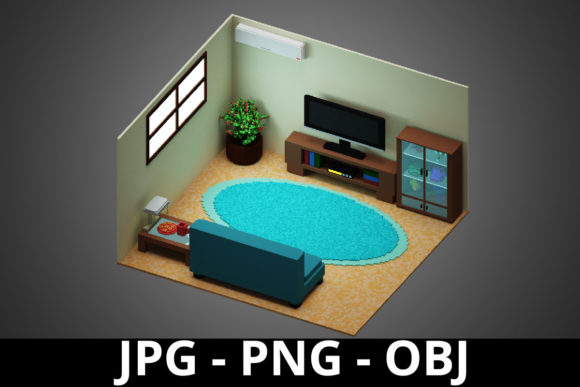
The core appeal of 3d Rendering Family Room Voxel Art lies in its clarity and readability. Because every element—from the sofa and table to the window and vase—is composed of discrete blocks, the spatial relationships within the room are immediately apparent. This makes it an excellent tool for quick concepting, where the goal is to communicate layout and volume rather than surface texture fidelity.
Key Visual Components
- Furniture and Decor: In a voxel environment, items such as a seat, lounge chair, or carpet are built from stacked cubes. While this limits organic curves, it allows for precise alignment and modular design, which can be advantageous for grid-based systems.
- Lighting and Atmosphere: Despite the blocky geometry, modern rendering engines can simulate soft shadows, ambient occlusion, and dynamic light sources. A well-rendered voxel scene can convey a sense of luxury and comfort through strategic use of warm tones and realistic shadow casting, despite the simplified geometry.
- Architectural Elements: Walls, floors, and ceilings are rendered with clear edges. The use of materials like wood flooring or textured walls adds depth without requiring high-resolution texture maps, relying instead on color variation and shading techniques inherent to the voxel format.
Comparison with Traditional 3D Rendering Styles
When deciding on a visualization method, it is crucial to understand how 3d Rendering Family Room Voxel Art stacks up against other prevalent styles. The choice often depends on the intended platform, target audience, and desired level of realism.
Voxel vs. Photorealistic Polygonal Modeling
Photorealistic rendering aims to replicate real-world photography as closely as possible, utilizing complex shaders, high-polygon counts, and detailed texture maps. In contrast, voxel art embraces abstraction. While a photorealistic render might show the grain of individual wood fibers on a table, a voxel render suggests the presence of wood through color palette and block arrangement.
Decision Factor: Choose photorealistic rendering when the client needs to visualize exact material finishes, intricate molding details, or lifelike lighting conditions for high-end residential sales. Opt for voxel art when the focus is on spatial planning, stylistic branding, or when working within performance constraints typical of mobile devices or web-based applications.
Voxel vs. Isometric Vector Illustration
Isometric vector illustrations also use a pseudo-3D perspective but are created using flat shapes and lines. They offer crisp edges at any scale but lack the volumetric depth that voxels provide. Voxel art, being inherently three-dimensional, allows for true rotation and multi-angle viewing, whereas vector isometrics are often fixed in orientation.
Tradeoff: Voxel assets can be rotated freely in 3D space, allowing for dynamic camera angles in presentations or interactive experiences. However, they require more computational power to render in real-time compared to lightweight vector graphics, which load instantly across all browsers.
Technical Advantages and Workflow Considerations
The workflow for creating 3d Rendering Family Room Voxel Art differs significantly from traditional 3D modeling. Many voxel tools operate on a grid system, which simplifies the process of placing objects and ensuring consistent proportions. This grid-based approach is particularly useful for generating standardized layouts for residential projects.
Asset Management and File Formats
Projects involving voxel art often come packaged in versatile formats to support various use cases. A typical ZIP folder containing these assets might include:
- JPG and PNG Files: These raster formats are ideal for immediate use in presentations, websites, or marketing materials. High-resolution exports ensure that the image remains sharp even when scaled up for large displays.
- OBJ Layouts: The OBJ file format is a widely supported 3D data format that preserves geometry and texture coordinates. This allows designers to import the voxel scene into other 3D software for further modification, animation, or integration into larger environments.
- Isometric Perspective Views: Pre-rendered isometric views are valuable for UI design, map creation, and static background scenes. They provide a consistent angle that is easy for users to interpret spatially.
Performance and Scalability
One of the primary strengths of voxel art is its scalability. Because the geometry is composed of simple cubes, it is generally less computationally expensive than high-poly meshes. This makes 3d Rendering Family Room Voxel Art suitable for applications where performance is critical, such as online configurators or augmented reality (AR) apps running on smartphones.
However, there are tradeoffs. Achieving smooth curves or complex organic shapes, such as draped fabric on a sofa or the intricate design of a vase, requires a higher resolution of voxels, which can increase file size and rendering time. Designers must balance detail level with performance requirements.
Best-Fit Situations for Voxel Interior Renders
Not every project benefits from a voxel aesthetic. Understanding the specific contexts where this style excels helps in making informed decisions.
Ideal Use Cases
- Game Development: For indie games or mobile titles focused on simulation, building, or cozy lifestyle themes, voxel art provides a charming and cohesive visual language.
- Conceptual Architecture: Architects may use voxel models to quickly explore massing, sunlight penetration, and spatial flow before committing to detailed blueprints.
- User Interface Design: App icons, dashboard backgrounds, and instructional guides often utilize voxel art to create engaging, non-distracting visuals that convey information clearly.
- Marketing Materials: Brands seeking a modern, tech-savvy, or playful identity may find voxel renders more distinctive than generic stock photos of living rooms.
When to Choose Alternatives
If the project requires showcasing specific high-end furniture brands with intricate detailing, or if the client demands a hyper-realistic depiction of lighting and material reflection for sales purposes, traditional 3D rendering or photography would be more appropriate. Voxel art abstracts details, which can sometimes obscure the quality of premium products.
Evaluating Quality and Detail in Voxel Renders
Not all voxel renders are created equal. When evaluating samples of 3d Rendering Family Room Voxel Art, consider the following criteria:
- Resolution and Sharpness: Higher voxel density allows for smoother transitions between colors and shapes. Check if the edges appear jagged or if the anti-aliasing is sufficient for professional presentation.
- Lighting Realism: Even in a stylized format, lighting should feel natural. Look for consistent shadow directions, soft global illumination, and reflections that enhance the sense of depth.
- Color Harmony: A well-designed voxel scene uses a cohesive color palette. Clashing colors or poor contrast can make the room feel chaotic rather than comfortable.
- Completeness: Ensure that all necessary elements are present, including decor, furniture, and architectural features. An empty room may look unfinished unless specifically intended for customization.
Conclusion: Making the Right Choice
The decision to use 3d Rendering Family Room Voxel Art depends largely on the objectives of your project. It offers a unique blend of artistic charm and technical efficiency, making it a powerful tool for digital visualization in specific contexts. By understanding its strengths—such as clarity, scalability, and stylistic distinctiveness—and its limitations regarding detail and realism, you can determine whether this approach fits your needs.
For those seeking a modern, engaging, and performance-friendly way to represent indoor spaces, voxel art provides a compelling alternative to traditional methods. Whether used for game assets, architectural concepts, or creative marketing, the right implementation of voxel rendering can elevate the visual narrative of any family room design project.